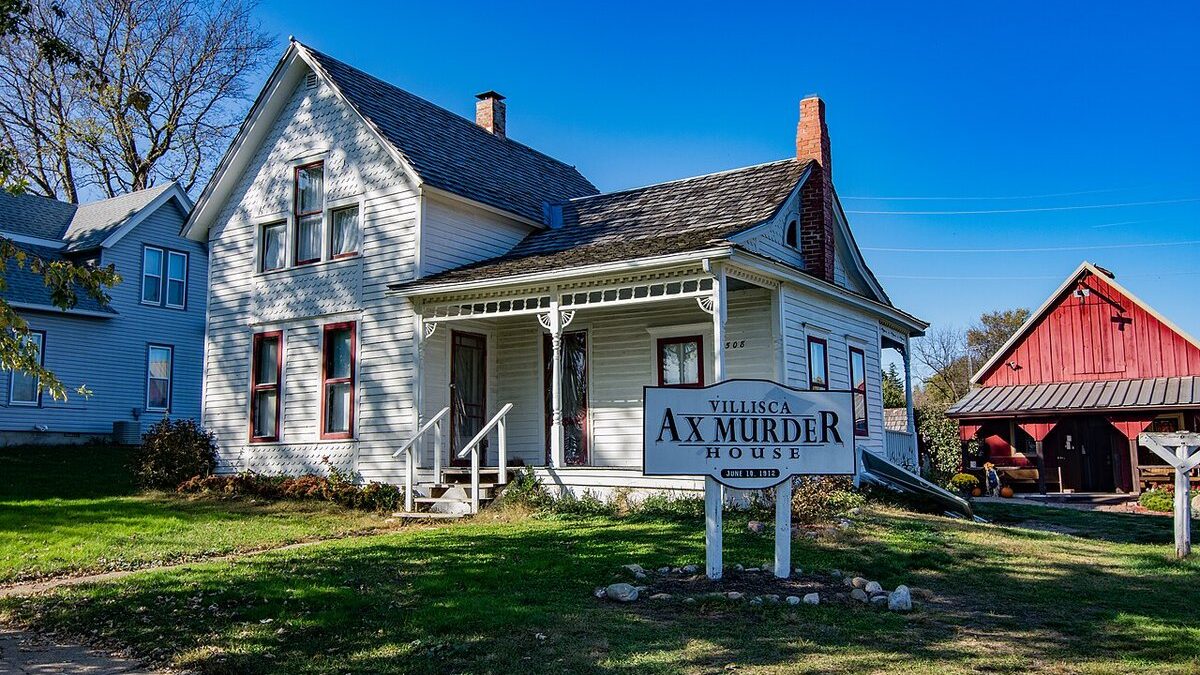
In the early morning hours of June 10, 1912, the quiet agricultural town of Villisca, Iowa, was the scene of the most horrific and enigmatic mass homicide in American pioneer history. The Villisca Axe Murders 1912 Iowa claimed the lives of an entire prominent family of six and two visiting overnight neighbor girls while they slept in their beds. Characterized by bizarre ritualistic behaviors—including draping mirrors with clothing, covering victims’ faces, and leaving an untouched slab of bacon beside the murder weapon—the crime triggered multi-decade political feuds, private detective wars, and a century of forensic fascination.
Executive Case Factsheet
- Victim(s): 8 fatalities: Josiah B. Moore (43), Sarah Moore (39), Herman Moore (11), Katherine Moore (10), Boyd Moore (7), Paul Moore (5), Lena Stillinger (12), Ina Stillinger (8)
- Date of Incident: June 9–10, 1912
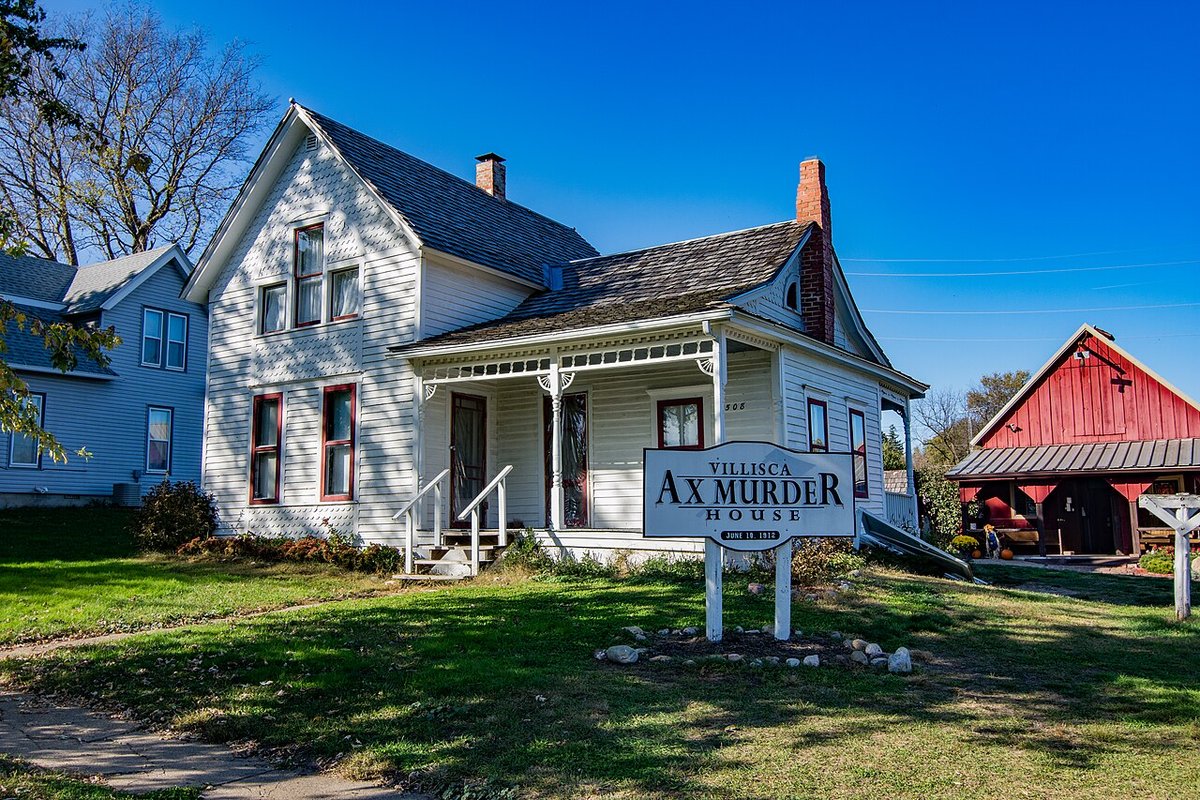
- Primary Crime Scene / Location: Moore Family Residence, 508 East 2nd Street, Villisca, Montgomery County, Iowa
- Lead Investigating Jurisdictions: Montgomery County Sheriff’s Office, Iowa Bureau of Criminal Investigation, Burns National Detective Agency
- Key Forensic Evidence: Eight-pound Moore family work axe with blunt-end cranial fractures, mirror and window coverings with clothing, plate of uneaten food and slab of bacon on kitchen table, kerosene lamp placed at foot of beds, bloodhounds scent tracking
- Suspect(s) / Perpetrator(s): Reverend George Kelly (tried twice and acquitted in 1917); State Senator Frank F. Jones; William ‘Blackie’ Mansfield; serial killer Paul Mueller
- Legal Outcome & Status: Officially unsolved historical eightfold homicide
The Quiet Night after Children’s Day: June 9–10, 1912
On Sunday evening, June 9, 1912, forty-three-year-old Josiah ‘Joe’ Moore, a prosperous farm implement merchant, and his thirty-nine-year-old wife, Sarah, attended the annual Children’s Day Program at the local Presbyterian Church with their four children: Herman (11), Katherine (10), Boyd (7), and Paul (5). Accompanying the family home to spend the night were two neighborhood neighbor sisters, twelve-year-old Lena Stillinger and eight-year-old Ina Stillinger.
The family returned to their modest white wood-frame home at 508 East 2nd Street around 9:45 p.m. and retired to bed. Sometime between midnight and 5:00 a.m. on Monday, June 10, an intruder who had concealed himself in the home’s attic descended the staircase wielding Josiah Moore’s own eight-pound timber work axe.
At approximately 7:30 a.m., neighbor Mary Peckham noticed that the Moore house was eerily silent, the livestock un-tended, and the doors locked. Peckham contacted Josiah’s brother, Ross Moore, who unlocked the door with a spare key. Stepping into the dark master bedroom, Ross Moore discovered Josiah and Sarah brutally bludgeoned to death in their bed, their heads and upper bodies covered with sheets, prompting an immediate town-wide alarm.
The Bizarre Crime Scene and Forensic Pathology Observations
When Montgomery County Coroner Dr. J.C. Linquist and local physician Dr. F.S. Williams inspected the residence, they encountered a scene of calculated, ritualistic precision. All eight victims had been struck in the head with the blunt side of the axe as they slept, fracturing their skulls, with subsequent lacerations inflicted with the blade side.
Forensic analysis revealed numerous extraordinary behavioral anomalies:
- Face and Mirror Coverings: The killer had placed clothing, skirts, and bedding over the faces of every single victim. Furthermore, the killer systematically covered every mirror in the house and every glass window with dresses and sheets taken from dressers.
- Lighting Discipline: A kerosene lamp was found resting on the floor at the foot of Josiah’s bed and another at the foot of the Stillinger girls’ bed, both with their chimneys removed and wicks turned low, proving the killer navigated the darkened rooms by faint, controlled candlelight.
- The Kitchen Tableau: In the kitchen, detectives discovered a two-pound slab of cured raw bacon wrapped in a cloth lying on the floor beside the bloodstained axe, a pan of bloody wash water on the stove, and a plate of uneaten food on the dining table.
- Defense Wounds: Only twelve-year-old Lena Stillinger displayed signs of waking and defending herself, bearing defensive bruises on her arm and lying crosswise on the bed with her undergarments pulled down, though medical examination confirmed no sexual assault occurred.
The Burns Detective Agency and the Political Vendetta
The investigation quickly devolved into a bitter political conflict between local law enforcement and hired private investigators. Montgomery County authorities engaged James Newton Wilkerson, an aggressive operative from the famous Burns National Detective Agency in Kansas City. Wilkerson developed a passionate theory implicating Iowa State Senator Frank Fernando Jones, a wealthy local businessman and political rival of Josiah Moore.
Wilkerson alleged that Senator Jones had hired a notorious transient hobo and rail worker named William ‘Blackie’ Mansfield to assassinate Joe Moore for $2,000 due to a bitter commercial feud regarding farm implement dealerships and an alleged romantic affair involving Jones’s daughter-in-law. Wilkerson claimed that Mansfield was a traveling serial axe killer who had committed identical axe murders in Blue Island, Illinois, and Paola, Kansas.
Mansfield was arrested and brought before a Montgomery County grand jury in 1916. However, Mansfield produced pristine payroll records and timecards proving he was working at a meat packing plant in Milwaukee, Wisconsin, on the night of the murders. A grand jury refused to indict Mansfield, and Senator Jones subsequently won a massive slander lawsuit against Detective Wilkerson, ending the political conspiracy theory.
The Trials and Acquittal of Reverend George Kelly
In 1917, authorities turned their attention to Reverend Lyn George Jacklin Kelly, an eccentric, diminutive traveling English Methodist minister who had attended the Children’s Day service in Villisca on June 9 and departed on a 5:19 a.m. train on June 10. Kelly had exhibited bizarre sexual obsessions, peeked into local windows, and mailed rambling letters to investigators confessing that God had commanded him to ‘slay utterly’ the Moore family.
Reverend Kelly was arrested and signed a formal written confession while being interrogated by state detectives. However, at his 1917 trial in Red Oak, Iowa, Kelly recanted his confession, testifying that state agents had subjected him to continuous psychological torture, sleep deprivation, and physical intimidation.
Defense attorneys presented psychiatric testimony proving Kelly was mentally unstable and prone to false confessions. The first trial resulted in a hung jury (8 to 4 for acquittal), and a second trial in November 1917 resulted in a unanimous Not Guilty verdict, leaving the prosecution without any remaining indicted suspects.
Modern Historical Criminology: The Paul Mueller Serial Theory
In recent years, modern forensic historians—most notably Bill James and Rachel McCarthy James in their 2017 historical study The Man from the Train—have applied modern data analytics to historical railroad timetables and unsolved early-20th-century axe homicides. Their research identified an itinerant German immigrant farmhand named Paul Mueller, who had been the prime suspect in an identical 1898 family axe murder in Massachusetts.
Between 1898 and 1912, over a dozen multi-victim family axe murders occurred within walking distance of railway junctions across the Midwest and Pacific Northwest (including axe massacres in Colorado Springs, Monmouth, and Ellsworth). All shared identical forensic signatures: striking victims while asleep with the blunt side of an axe, covering faces and mirrors with cloth, and utilizing removed lamp chimneys.
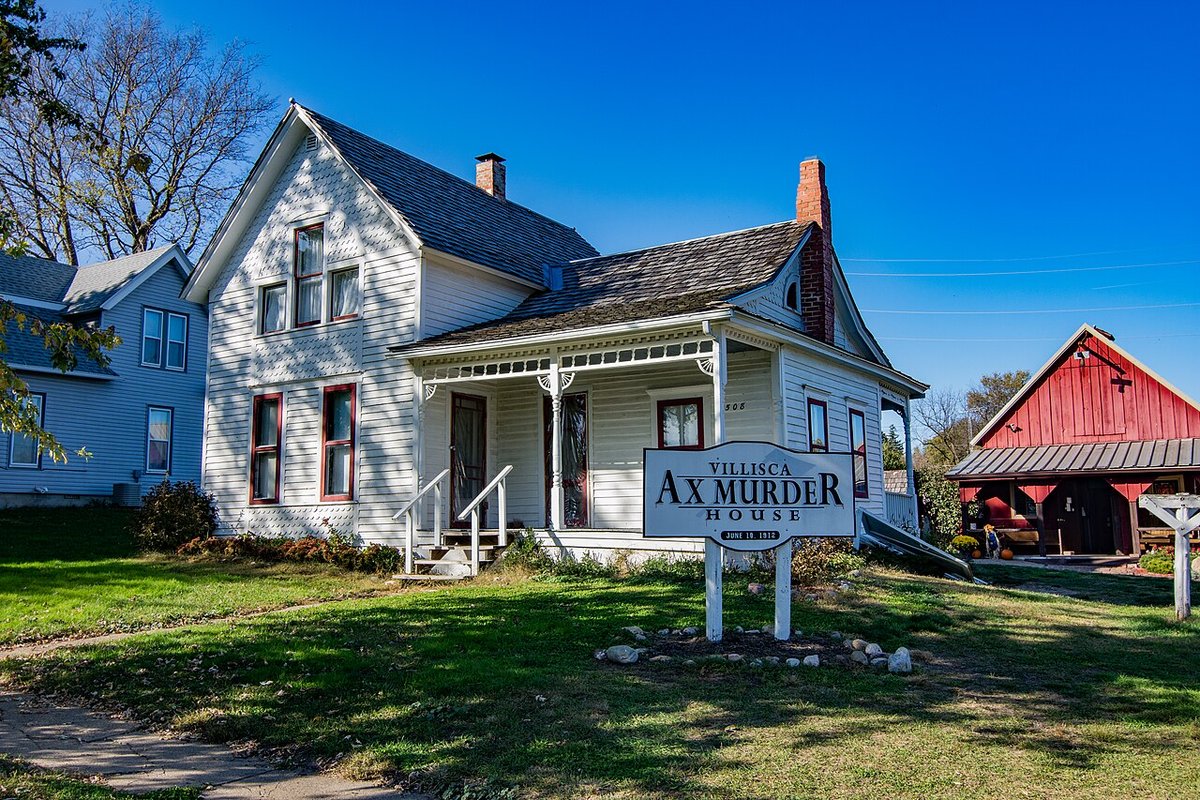
The Villisca Axe Murder House remains standing today as a preserved historical museum and landmark listed on the National Register of Historic Places, serving as a monument to one of the most chilling, enduring unsolved mysteries in American criminal history.
Chronological Case Timeline
| Date / Milestone | Investigative Development | Forensic / Evidentiary Significance |
|---|---|---|
| June 9, 1912 | Moore family attends Children’s Day service | Last confirmed public sighting of the family alive |
| June 10, 1912 | Eight bodies discovered inside Moore home | Ross Moore finds victims; town-wide alarm mobilized |
| June 1912 | Bloodhounds track scent to railway tracks | Confirms killer navigated rail corridors out of Villisca |
| 1916 | Grand jury clears suspect ‘Blackie’ Mansfield | Mansfield provides Wisconsin employment alibi; Wilkerson discredited |
| May 1917 | Reverend George Kelly arrested | Signs written confession; claims divine command |
| November 1917 | Reverend Kelly acquitted at second trial | Jury finds confession coerced; no further indictments filed |
Frequently Asked Questions: Forensic & Legal Review
What happened in the Villisca Axe Murders of 1912?
Eight people—Josiah and Sarah Moore, their four children, and two visiting neighbor girls (Lena and Ina Stillinger)—were bludgeoned to death in their sleep with an axe inside their Villisca, Iowa home on the night of June 9–10, 1912.
What strange forensic details were found at the Villisca crime scene?
The killer covered the faces of all eight victims with bedsheets and clothing, draped coats and dresses over every mirror and window in the house, placed kerosene lamps at the foot of beds with wicks turned low, and left a slab of raw bacon wrapped in cloth beside the axe in the kitchen.
Who was tried for the Villisca murders?
Traveling Methodist minister Reverend George Kelly was tried twice in 1917 after signing a confession. However, he recanted at trial, proving the confession was extracted under severe police coercion and sleep deprivation, resulting in a unanimous acquittal.
What is the modern ‘Man from the Train’ serial killer theory?
Modern crime historians hypothesize that an itinerant German rail traveler named Paul Mueller committed the Villisca murders as part of a multi-state serial axe murder spree between 1898 and 1912, targeting families near railroad depots with identical forensic signatures.