Executive Case Factsheet
- Perpetrator: Raman Raghav (also known as Sindhi Dalwai, “Psycho Raman”, “The Pavement Killer”)
- Active Period: 1965 – 1968 (Captured August 27, 1968)
- Jurisdiction: Suburbs of Mumbai (Bombay), Maharashtra, India (Malad, Kandivali, Borivali, Ghatkopar)
- Confirmed Victims: Confessed to 41 murders (pavement dwellers, shanty residents, and sleeping watchmen)
- Modus Operandi: Stalking homeless pavement dwellers sleeping along railway tracks and open verandas; nocturnal bludgeoning with a customized heavy iron rod (crowbar) with a bent hook; zero robbery or financial motive
- Key Forensic Breakthrough: Coordinated suburban patrol dragnet directed by DCP Ramakant Kulkarni; alert spotting of Raghav carrying a wet umbrella and suspicious iron rod in Bhendi Bazaar; recovery of victim trinkets from bush hiding spots
- Judicial Outcome: Convicted and sentenced to death by the Sessions Court in 1969; commuted to life imprisonment by the Bombay High Court on grounds of chronic paranoid schizophrenia; died in 1995 at Yerwada Central Jail
During the mid-to-late 1960s, the commercial metropolis of Mumbai (then Bombay) was paralyzed by terror as a reclusive serial predator known as “Psycho Raman” carried out nocturnal bludgeoning attacks against the city’s most vulnerable inhabitants. Targeting destitute pavement dwellers and laborers sleeping along suburban railway tracks, Raman Raghav claimed at least 41 lives using a customized iron rod. His capture by the Mumbai Police and subsequent psychiatric evaluation became a watershed moment for Indian forensic psychiatry and criminal jurisprudence.
The Subterranean Slums & Pavement Stalking Corridors
Born in Tamil Nadu in 1929, Raman Raghav migrated to Mumbai as a youth, spending years in juvenile institutions and prisons for theft and physical assault. By the mid-1960s, Raghav lived as a nomadic vagrant, sleeping in the dense mangrove swamps, drainage pipes, and forested outskirts bordering the Western and Central railway lines.
Raghav developed a ruthless, nocturnal stalking method. Between 1:00 AM and 4:00 AM, he roamed the suburban districts of Malad, Kandivali, Borivali, and Ghatkopar. He scouted open verandas, construction sites, and railway embankments where impoverished pavement dwellers and night watchmen slept under canvas sheets. Approaching silently in bare feet, Raghav delivered crushing blunt-force blows to his victims’ skulls with a heavy, customized iron crowbar, killing entire sleeping families without uttering a sound.
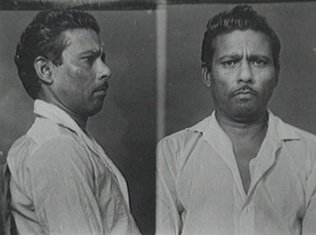
Forensic Pathology: Cranial Trauma & Weapon Signatures
The forensic autopsies conducted at the Cooper Hospital and J.J. Hospital mortuaries revealed horrific injuries. Forensic pathologists documented extensive comminuted skull fractures, depression of the parietal and occipital bones, and massive intracranial hemorrhages inflicted by a blunt, cylindrical weapon.
Pathologists noted that every victim sustained identical circular fracture impressions matching an industrial iron rod with a distinctive hook modification. The total absence of defensive wounds confirmed that the victims were ambushed while in deep sleep. Furthermore, because money and valuables were routinely left untouched on the bodies, investigators realized the killer was driven entirely by deep-seated psychological delusions rather than material gain.
The 1968 Manhunt & The Bhendi Bazaar Apprehension
In August 1968, following a wave of twelve murders in a single week in the northern suburbs, Mumbai Police mobilized over 2,000 officers under Deputy Commissioner of Police Ramakant S. Kulkarni. Curfews were imposed across suburban shantytowns, and armed police squads patrolled the railway corridors.
On August 27, 1968, Sub-Inspector Alex Fialho spotted a disheveled man walking through the Bhendi Bazaar district in South Mumbai. Fialho noticed that the suspect carried an old umbrella and an unusually heavy object wrapped in cloth, and that his bush shirt was stained with dried blood. Fialho detained the man, who was quickly identified as Raman Raghav. In his possession, detectives found the customized iron crowbar, two knives, and personal items belonging to recent victims.

The Psychiatric Evaluation & Bombay High Court Verdict
In custody, Raghav initially refused to speak until detectives provided him with a South Indian meal of chicken curry. He then delivered a comprehensive confession detailing 41 murders, guiding investigators to dense underbrush in Aarey Milk Colony where he had buried bloodstained weapons and victim keepsakes. Raghav claimed he acted under direct orders from supernatural forces and cosmic radio waves.
During his 1969 trial before the Additional Sessions Court of Greater Bombay, the defense raised an insanity plea under Section 84 of the Indian Penal Code (McNaghten Rules). While the trial court initially sentenced Raghav to death, the Bombay High Court ordered extensive psychiatric evaluations by Dr. B.G. Patankar and a special medical board. The board diagnosed Raghav with chronic, incurable paranoid schizophrenia with grandiose religious delusions. Consequently, the High Court commuted his death sentence to life imprisonment, ordering him transferred to the Yerwada Central Jail psychiatric ward in Pune, where he remained until his death in 1995.
Forensic Psychiatry & The Legal Standards of Paranoid Schizophrenia
The trial of Raman Raghav (‘Psycho Raman’) before the Bombay High Court served as a foundational milestone for the interpretation of Section 84 of the Indian Penal Code and the McNaghten legal insanity defense in South Asia. A special board of forensic psychiatrists from the J.J. Hospital and Mental Hospital, Yerwada, subjected Raghav to extensive clinical evaluations.
Psychiatrists documented that Raghav suffered from chronic, severe paranoid schizophrenia characterized by systematized persecutory and grandiose religious delusions. Raghav genuinely believed that supernatural powers communicated with him through radio waves and compelled him to bludgeon pavement dwellers to maintain cosmic balance. The Bombay High Court’s decision to commute his death sentence to life imprisonment established that profound psychotic illness that deprives an offender of the cognitive capacity to understand the nature and wrongfulness of their act must preclude capital punishment.
Weapon Forensics: Biomechanical Force of the Iron Crowbar
Forensic autopsies conducted on Raman Raghav’s 41 victims by Mumbai medical examiners revealed catastrophic cranial trauma. The customized heavy iron rod—fitted with an angled hook—delivered massive kinetic energy upon impact, crushing the frontal, parietal, and temporal bones in single blows.
Pathologists noted that because attacks occurred while victims slept on pavement verandas and railway tracks, there was a total absence of defensive forearm fractures, highlighting the terrifying predatory efficiency of nocturnal strikes against Mumbai’s most destitute demographic.
Chronological Case Timeline
| Date / Period | Investigative & Legal Milestone |
|---|---|
| 1929 | Raman Raghav is born in Tamil Nadu, India. |
| 1965 – 1966 | First wave of pavement homicides in Mumbai eastern suburbs (19 victims). |
| Mid-1968 | Second wave of suburban pavement bludgeonings in Malad and Kandivali. |
| August 27, 1968 | Sub-Inspector Alex Fialho captures Raghav in Bhendi Bazaar; iron weapon recovered. |
| September 1968 | Raghav confesses to 41 murders; guides police to physical evidence in Aarey Colony. |
| 1969 | Sessions Court sentences Raghav to death; commuted to life imprisonment by Bombay High Court. |
| 1995 | Raman Raghav dies of kidney failure at Sassoon Hospital, Pune, at age 66. |
Forensic Evidence Matrix & Criminological Assessment
The legal and psychiatric proceedings in the Raman Raghav case established foundational precedents for the insanity defense in India. Key evidential elements include:
- Customized Crowbar Biomechanics: Autopsies documented catastrophic comminuted cranial fractures inflicted by a hooked iron rod without defensive wounds on sleeping victims.
- Psychiatric Board Evaluation: Detailed clinical documentation of chronic paranoid schizophrenia and cosmic delusions leading to the Bombay High Court’s life imprisonment ruling.
- Suburban Dragnet Tactics: Over 2,000 police officers mobilized under DCP Ramakant Kulkarni, culminating in Sub-Inspector Fialho’s Bhendi Bazaar apprehension.
The Psycho Raman case remains a landmark in Indian forensic psychiatry and urban serial homicide investigation.
Related Case Files & Investigative Dossiers
Explore related deep-dive investigations into international serial homicides, forensic psychiatry landmarks, and historic manhunts:
- Auto Shankar: The Chennai Auto-Rickshaw Murders, Cinema Abductions & Central Prison Trial
- Javed Iqbal: The Lahore 100 Runaways, Hydrochloric Acid Vats & The December 1999 Confession
- Thug Behram: The Thuggee Cult Leader, Silk Rumal Strangulations & Sleeman’s Inquest
- Andrei Chikatilo: The Butcher of Rostov, Operation Forest & Forensic Psychiatry
- Richard Ramirez: The Night Stalker, AFIS Fingerprint ID & East LA Capture
Frequently Asked Questions
Who was Raman Raghav and why was he called Psycho Raman?
Raman Raghav was an Indian serial killer who murdered 41 homeless pavement dwellers and laborers in Mumbai between 1965 and 1968, bludgeoning them in their sleep with a customized iron rod.
How did Mumbai Police capture Raman Raghav?
Sub-Inspector Alex Fialho spotted Raghav in Bhendi Bazaar carrying a wet umbrella and an unusually heavy cloth-wrapped iron rod with bloodstains on his shirt, leading to his arrest.
Why was Raman Raghav’s death sentence commuted?
The Bombay High Court commuted his death sentence to life imprisonment after a panel of forensic psychiatrists determined he suffered from chronic, severe paranoid schizophrenia and was acting under delusional psychosis.
{
“@context”: “https://schema.org”,
“@type”: “FAQPage”,
“mainEntity”: [
{
“@type”: “Question”,
“name”: “Who was Raman Raghav and why was he called Psycho Raman?”,
“acceptedAnswer”: {
“@type”: “Answer”,
“text”: “Raman Raghav was an Indian serial killer who murdered 41 homeless pavement dwellers and laborers in Mumbai between 1965 and 1968, bludgeoning them in their sleep with a customized iron rod.”
}
},
{
“@type”: “Question”,
“name”: “How did Mumbai Police capture Raman Raghav?”,
“acceptedAnswer”: {
“@type”: “Answer”,
“text”: “Sub-Inspector Alex Fialho spotted Raghav in Bhendi Bazaar carrying a wet umbrella and an unusually heavy cloth-wrapped iron rod with bloodstains on his shirt, leading to his arrest.”
}
},
{
“@type”: “Question”,
“name”: “Why was Raman Raghav’s death sentence commuted?”,
“acceptedAnswer”: {
“@type”: “Answer”,
“text”: “The Bombay High Court commuted his death sentence to life imprisonment after a panel of forensic psychiatrists determined he suffered from chronic, severe paranoid schizophrenia and was acting under delusional psychosis.”
}
}
]
}