

Case File Dossier: Thelma Pauline “Polly” Melton (1981)
- Victim: Thelma Pauline “Polly” Melton (Age 58) — Church & Community Volunteer
- Date of Disappearance: Friday, September 25, 1981 (~4:00 PM EST)
- Location: Deep Creek Campground Loop Trail, Great Smoky Mountains NP, NC
- Companions: Trula Bryson and Evelyn Cole (Lifelong Friends & Volunteers)
- Personal Effects Left Behind: Leather handbag, driver’s license, wallet, cash, vehicle, critical daily prescription medications
- Primary Investigating Agencies: National Park Service ISB, Swain County Sheriff’s Office
- Current Status: Active Unsolved Missing Person Cold Case
- Investigation Desk: National Park Disappearances
On the pleasant autumn afternoon of September 25, 1981, 58-year-old Thelma Pauline “Polly” Melton was enjoying a peaceful picnic lunch with two of her closest lifelong friends at the Deep Creek recreation area within the North Carolina sector of Great Smoky Mountains National Park. Following their meal, the three women embarked on a gentle, leisurely walk along the flat, graded surface of the Deep Creek Loop Trail. Without uttering a single word of explanation, Polly suddenly accelerated her walking pace, stepped roughly one hundred feet ahead over a minor trail knoll, and vanished from sight. She was never seen or heard from again.
Polly Melton was no novice in the Appalachian foothills; she was a lifelong resident of nearby Bryson City who had walked the trails of the Great Smokies for decades. She was not a backcountry hiker lost in extreme wilderness, but an active community volunteer who vanished within hearing distance of her companions on one of the most accessible and heavily frequented recreation paths in the national park system. Her unexplained disappearance left behind her handbag, her locked vehicle, and the critical daily medications essential for her survival, instigating an investigation that continues to baffle law enforcement four decades later.

The Deep Creek Outing & The Unannounced Departure
The Deep Creek section of Great Smoky Mountains National Park, situated approximately three miles north of Bryson City, North Carolina, is renowned for its tranquil mountain streams, cascading waterfalls, and wide, gently sloping riverside paths. It is a favorite destination for local residents and tourists seeking low-impact outdoor recreation.
On Friday, September 25, Polly Melton accompanied her longtime friends Trula Bryson and Evelyn Cole to the Deep Creek picnic grounds. The trio shared a close bond forged through years of community service and volunteer work with Meals on Wheels and their local church. Polly had recently coped with substantial personal stress—her mother had passed away earlier that year, and her husband, Bob Melton, was undergoing rehabilitation following a debilitating stroke. However, both friends emphasized that during their lunch, Polly appeared in good spirits, cheerful, and engaged in everyday conversation.
At approximately 3:45 PM, the group decided to embark on a short stroll along the Deep Creek Trail. Polly was dressed in casual street clothing: a vibrant pink blouse, navy blue trousers, and low-heeled walking shoes. Prior to setting off, Polly placed her leather purse—containing her identification, checkbook, cash, car keys, and vital daily prescription medications for blood pressure and nausea—securely inside her locked vehicle.
As they strolled along the riverside trail under a clear sky, Polly began to pick up her pace, pulling ahead of Trula and Evelyn. Her friends assumed Polly was simply stretching her legs in the brisk mountain air. When Polly crested a slight rise in the path roughly thirty yards ahead, she momentarily stepped beyond their field of view. Less than ninety seconds later, Trula and Evelyn reached the same crest. The trail stretched unobstructed before them for more than two hundred yards—yet Polly had completely vanished.
The Multi-Agency Search: 150 Rescuers in the Smokies
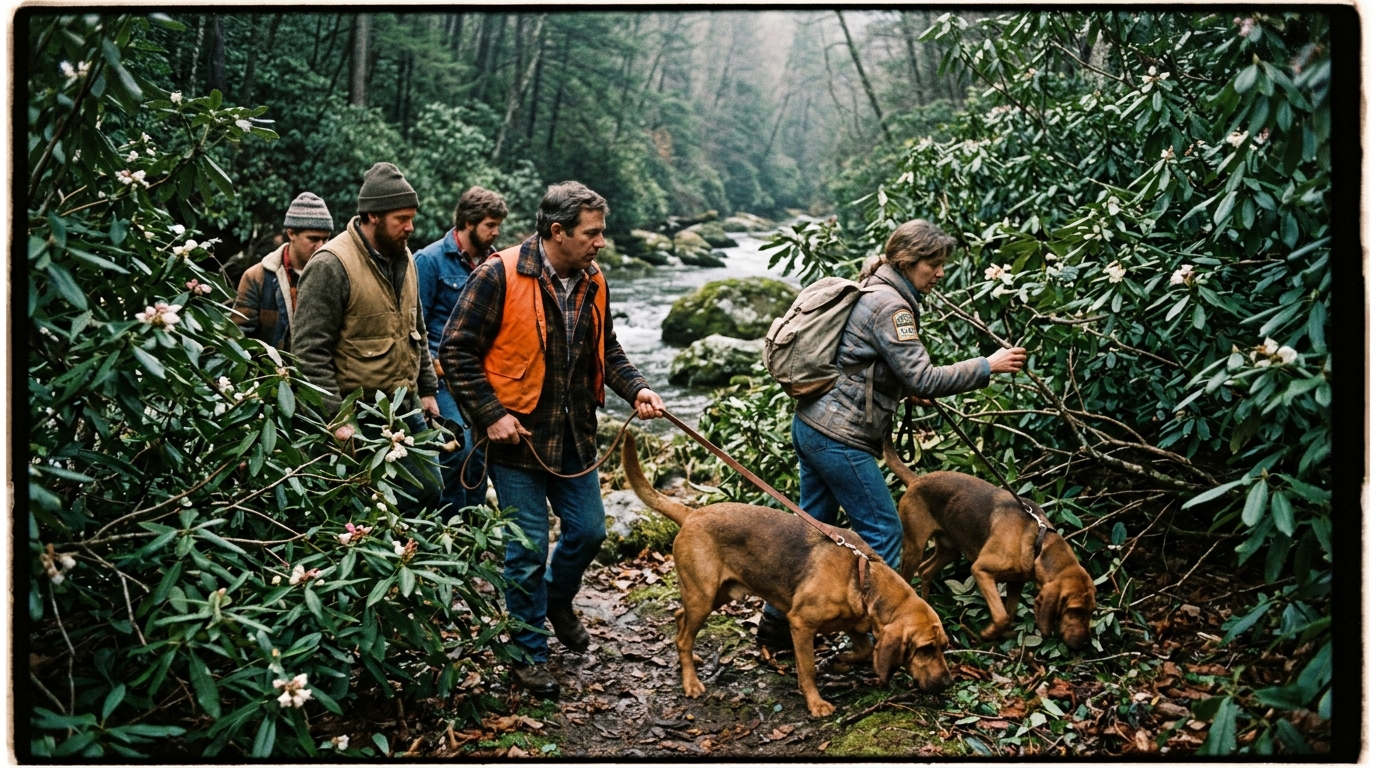
After frantically calling Polly’s name and scouring the immediate creek banks to no avail, Trula and Evelyn hurried to the Deep Creek ranger outpost to alert park authorities. Within hours, the National Park Service and the Swain County Sheriff’s Department launched an extensive tactical search and rescue mission.
Over the subsequent ten days, the operation grew into one of the largest search efforts in western North Carolina history:
- Ground Search Grids: Over 150 search personnel—comprising park rangers, Swain County deputies, volunteer firefighters, mountain rescue teams, and U.S. Forest Service personnel—combed every square yard of the Deep Creek drainage, Juney Whank Falls, Tom Branch Falls, and Indian Creek.
- Specialized K-9 Tracking Units: Master bloodhound and air-scent search dog teams were deployed. The tracking dogs detected Polly’s scent trailing off the main path, following a faint logging spur that ascended toward an old community cemetery located on the park boundary.
- Aerial Sweeps & Thermal Imaging: North Carolina State Highway Patrol helicopters equipped with Forward Looking Infrared (FLIR) sensors conducted low-level reconnaissance over the forest canopy.
Despite exhaustive efforts across hundreds of acres of dense hemlock, pine, and rhododendron undergrowth, searchers failed to uncover a single physical clue: no scraps of fabric from her bright pink blouse, no footprints in the creek mud, no scuffed rocks, and no scent continuation beyond the cemetery road.
Forensic Hypotheses & Investigative Evaluation
Investigators and cold case specialists have evaluated three primary working hypotheses:
1. Pre-Arranged Departure via a Perimeter Roadway
The specific behavior witnessed by her companions—suddenly walking ahead without speaking—coupled with the bloodhound trail ending at the cemetery boundary road, provides strong circumstantial support for a pre-arranged rendezvous. A vehicle parked along the secluded perimeter road could have received Polly and departed into Swain County within five minutes of her disappearance. However, financial and biometric checks reveal that Polly’s Social Security number, bank accounts, and health insurance were never accessed again. For a woman requiring daily medication to sustain a covert new existence without financial resources remains highly uncharacteristic.
2. Sudden Medical Event or Neurological Disorientation
Polly was under significant domestic stress and took multiple medications for high blood pressure and chronic health issues. Medical experts consulted on the case suggested that she may have suffered a sudden transient ischemic attack (TIA), aneurysm, or acute hypertensive disorientation that impaired her cognition and caused her to wander into the surrounding wilderness. Yet forensic searchers conducted tight-grid sweeps of every ravine, creek bed, and sinkhole within three miles; had an incapacitated person perished in the terrain, K-9 teams would have located the remains.
3. Third-Party Encounter and Foul Play
Another persistent theory investigates the possibility that Polly encountered a hostile individual on the trail or near the cemetery road, was abducted under threat of violence, and transported outside the national park. Swain County investigators questioned numerous individuals and explored potential local connections, but no suspect was ever formally charged or indicted.
Historical Parallels with Appalachian Cold Cases
Polly Melton’s disappearance shares profound similarities with other famous Great Smoky Mountains cold cases, notably the 1976 vanishing of Trenny Gibson on Forney Ridge and the 1969 disappearance of Dennis Martin at Spence Field. In all three instances, individuals vanished silently in broad daylight while in the immediate proximity of companions, leaving search dogs with scent trails that terminated abruptly at roadway margins.
Current Status & Official Cold Case Tip Reporting
The disappearance of Thelma Pauline “Polly” Melton remains an open cold case under active review. Law enforcement encourages anyone with historical records or relevant information to submit tips:
The Topographical Environment of the Deep Creek Drainage
To fully comprehend the extraordinary nature of Polly Melton’s disappearance, one must examine the specific physical geography of the Deep Creek recreation area. Unlike the precipitous, jagged ridgelines of Clingmans Dome or Mount LeConte, the lower reaches of Deep Creek occupy a relatively gentle mountain valley flanked by lush river bottoms, ancient hardwood groves, and rolling sub-ridges. The Deep Creek Trail itself is built upon the graded roadbed of a historic logging railway, providing an unusually wide, smooth, and unobstructed walking corridor that is virtually free of the treacherous boulder fields or sheer cliffs found elsewhere in the Great Smokies.
At the point where Polly was last observed by her companions, the trail meanders through a dense riparian forest of eastern hemlocks, tulip poplars, and mountain laurel. Visibility directly along the trail corridor extends for hundreds of feet in both directions. For an adult woman to vanish without a trace within a ninety-second window required either immediate, silent concealment within the rhododendron understory or rapid egress via an adjacent access path.
Forensic Scent Analysis & The Cemetery Spur Route
The deployment of professional bloodhound tracking units by regional law enforcement provided the most compelling physical clue in the investigation. When provided with an uncontaminated scent article obtained from Polly’s vehicle, the tracking dogs did not indicate any movement down the steep banks into the rushing waters of Deep Creek, nor did they follow the main trail deeper into the backcountry.
Instead, the bloodhounds followed a faint, disused footway that branched sharply off the main trail, ascending a wooded knoll toward a historic 19th-century community cemetery situated near the national park boundary. This quiet cemetery is accessible by an unpaved secondary road connecting to the rural outskirts of Bryson City. The canine scent trail proceeded along this spur path with high fidelity, continuing directly to the roadway shoulder before terminating completely.
Experienced canine handlers testified that the abrupt cessation of scent at the roadside strongly indicates that the subject entered an idling passenger vehicle. Because scent molecules pool at ground level and dissipate when an individual is elevated inside an enclosed automobile, the physical evidence points toward a vehicle-assisted departure from the park boundary within minutes of her separation from her companions.
The Psychological & Medical Profile: Analysis of Motive
Federal and county investigators conducted exhaustive interviews with Polly’s family members, church associates, and medical providers to evaluate her mental and physical state prior to the disappearance. While Polly had experienced emotional strain following the recent death of her mother and the demanding caretaking required for her husband Bob following his stroke, friends unanimously testified that she exhibited no signs of clinical depression, suicidal ideation, or desire to abandon her family.
From a medical perspective, Polly suffered from chronic hypertension and required daily prescription medication to regulate her cardiovascular stability. Medical examiners noted that an individual suffering from sudden acute hypertension or transient cerebral ischemia could experience severe spatial disorientation and confusion. However, had Polly wandered into the surrounding forest in a state of cognitive distress, her physical body would have remained within the immediate search area, where over 150 searchers and dozens of trained tracking dogs would have located her during the ten-day grid search.
Have Information on the Polly Melton Cold Case?
Please contact the official investigative agencies handling this case:
- Swain County Sheriff’s Office: (828) 488-2196
- NPS ISB Tip Line: Call/Text 888-653-0009 | Email:
[email protected] - Great Smoky Mountains Dispatch: (865) 436-1230
- True Crime Stories Tip Desk: Submit a confidential lead online.