Executive Case Factsheet
- Perpetrator: Unidentified serial killer (known as “The Axeman of New Orleans”)
- Active Period: May 1918 – October 1919 (Preceded by possible 1911–1912 attacks)
- Jurisdiction: New Orleans and Gretna, Louisiana, United States
- Confirmed / Linked Victims: 12 victims attacked across 8 separate home invasions (6 fatalities, 6 survivors)
- Modus Operandi: Chiseling out lower wooden door panels of Italian grocery stores and residential quarters; utilizing the victims’ own household axes or straight razors; nocturnal bludgeoning of sleeping families
- Key Evidentiary Artifact: The famous “Jazz Letter” sent to the Times-Picayune on March 13, 1919, demanding that all citizens play jazz music on March 19 to avoid being axed
- Judicial Outcome: Case officially unsolved; attacks abruptly ended in October 1919 following the murder of Mike Pepitone; no suspect was ever formally tried or convicted
Between May 1918 and October 1919, the city of New Orleans was gripped by terror as an elusive nocturnal intruder known as “The Axeman of New Orleans” carried out a series of brutal home-invasion attacks. Targeting primarily Italian-American immigrant grocers in their living quarters, the Axeman chiseled through rear doors, armed himself with tools found on the premises, and attacked sleeping families. His infamous correspondence demanding that the city play jazz music on St. Joseph’s Night became one of the most celebrated cultural artifacts in American criminological history.
The Italian Grocer Attacks & Forced Entry Signatures
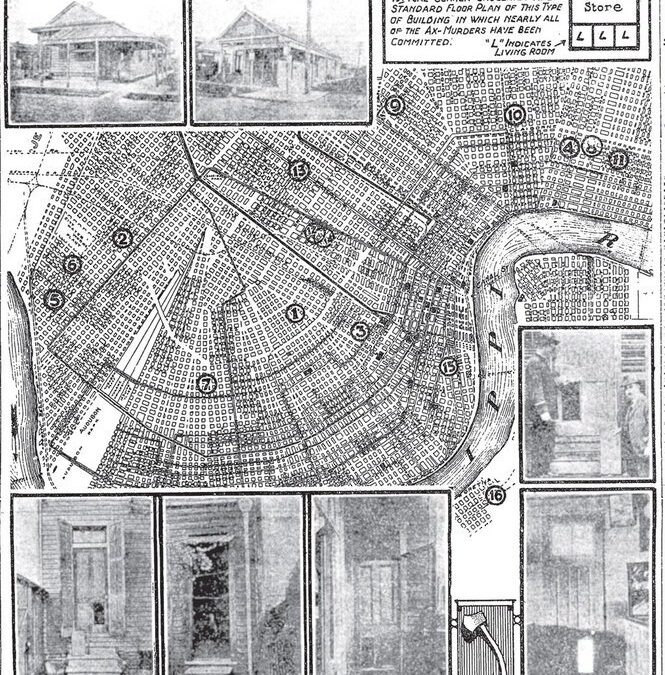
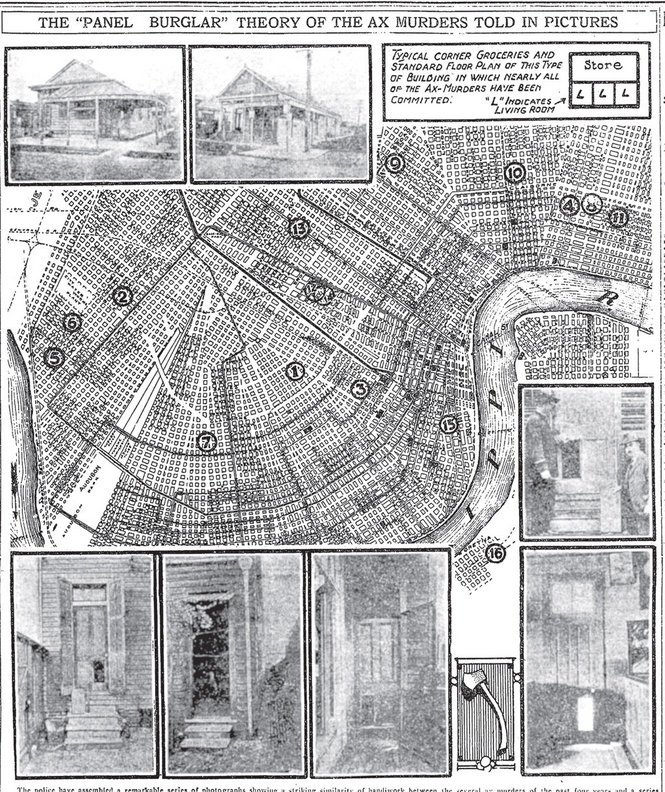
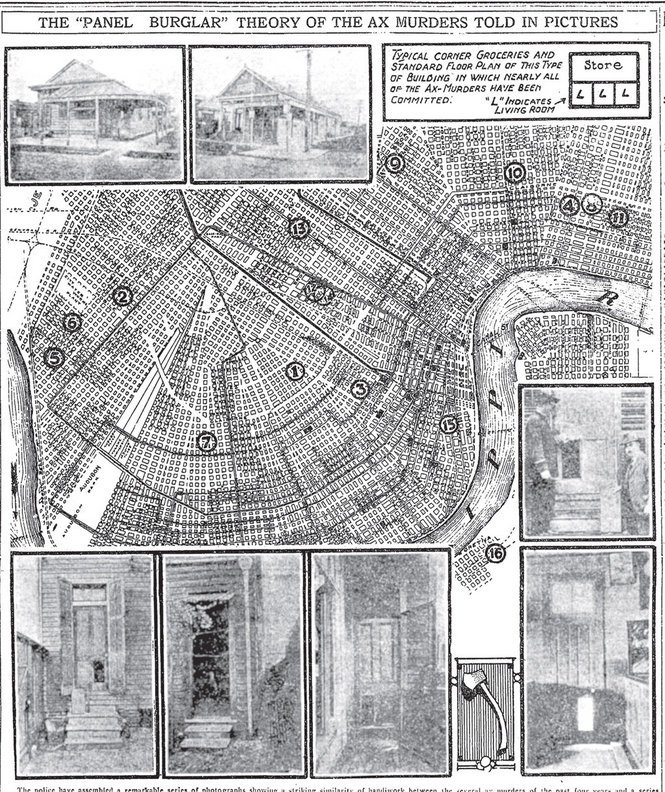
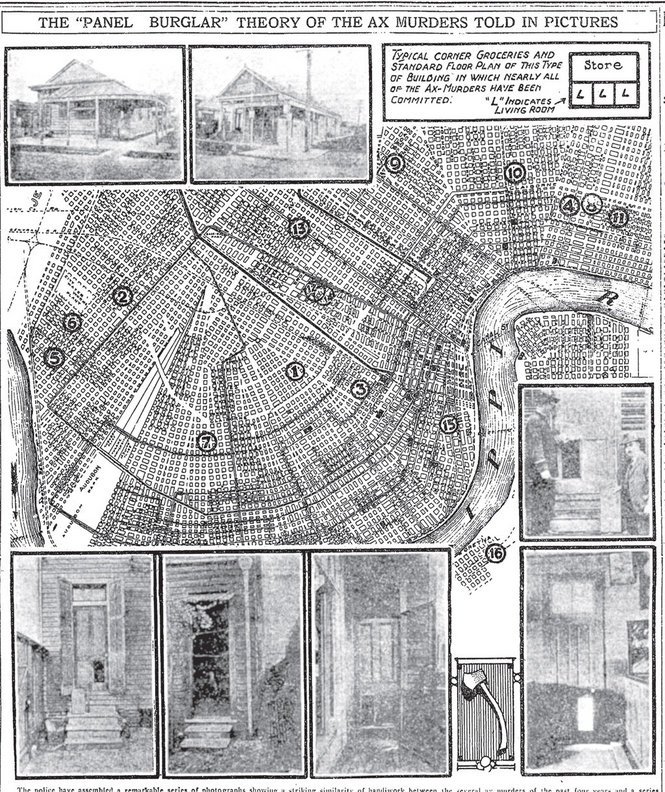
The terror began in the early morning hours of May 23, 1918, when Italian grocer Joseph Maggio and his wife Catherine were murdered in their bedroom behind their shop on Upperline and Magnolia Streets. Responding New Orleans Police Department (NOPD) officers discovered a consistent physical entry method: the perpetrator had used a carpenter’s chisel to remove the lower wooden panel of the back door, allowing him to reach inside and unlatch the door bolt.
Once inside, the intruder found Maggio’s own wood-chopping axe, bludgeoned the sleeping couple, slit their throats with a straight razor, and discarded the bloody weapons in the yard without taking cash or jewelry. Over the following eighteen months, identical attacks struck the households of grocers Louis Besumer, Edward Schneider, Joseph Romano, Charles Cortimiglia, and Mike Pepitone across New Orleans and Gretna.
Forensic Crime Scene Analysis & Chiseled Door Panels
NOPD Superintendent Frank Mooney coordinated citywide crime scene investigations. Physical examination of the crime scenes revealed striking consistency: every forced entry was executed using a 1-inch to 1.5-inch wood chisel, with the removed door slats neatly placed against adjacent walls. Forensic detectives noted that the intruder never brought his own murder weapon, instead locating the householder’s own axe or iron bar upon entering.
Pathological autopsies confirmed massive blunt-force cranial fractures delivered with extreme physical force. Despite extensive fingerprint dusting using graphite powders on the chiseled wood and axe handles, early 20th-century latent print recovery techniques yielded only smudged, unclassifiable impressions.
The March 1919 “Jazz Letter” & St. Joseph’s Night
On March 13, 1919, the editor of the Times-Picayune received a sensational letter claiming to originate from the Axeman himself. Written in theatrical, menacing prose, the author claimed to be a demon from Hell who possessed supernatural power over the city. The letter issued an extraordinary ultimatum:
“On next Wednesday night, at 12:15 (earthly time)… I will visit New Orleans… I will pass over every house where a full jazz band is in full swing… One thing is certain and that is that some of your people who do not jazz it on Tuesday night (if there be any) will get the axe.”
On Wednesday night, March 19, 1919 (St. Joseph’s Eve), the entire city of New Orleans erupted in live jazz. Dance halls, clubs, private parlors, and restaurants were packed with citizens playing brass bands and piano ragtime. True to the letter’s promise, no attacks occurred that night.
The Final Attack & The Unsolved Legacy
The attacks resumed in August 1919 with the assault on grocer Steve Boca, and concluded on October 27, 1919, when Mike Pepitone was struck and killed in his bedroom on Felicity Street. Following Pepitone’s death, the mysterious attacks abruptly ceased.
Several suspects were interrogated, including grocer Frank Mumphrey and Joseph Mumfre (who was fatally shot in Los Angeles in 1920 by Pepitone’s widow, Esther Albano, in an alleged revenge killing), but police records indicate no evidence tying Mumfre to the crimes. The Axeman of New Orleans remains one of America’s greatest unsolved criminal mysteries, representing a chilling intersection of immigrant targeting, early forensic investigations, and American jazz folklore.
Forensic Analysis of Toolmark Signatures & Forced Entry Mechanics
The crime scene investigations conducted by the New Orleans Police Department between 1918 and 1919 established a remarkably consistent forensic pattern of forced entry. At every crime scene, forensic detectives documented identical mechanical toolmarks on wooden back doors, where a 1.25-inch carpenter’s chisel was used to pry loose door slats with surgical precision.
The perpetrator consistently removed the lower door panel, reached through to slide the internal lock bolt, and entered silently in bare feet or stockinged feet. Crucially, the Axeman never brought a weapon to the scene, instead locating the householder’s own axe, hatchet, or iron bar. This behavioral signature demonstrated high situational adaptability and an intimate familiarity with the domestic layouts of Italian-American grocery residences.
Social Hysteria, Ethnic Targeting & American Jazz Folklore
The Axeman attacks occurred against a backdrop of intense anti-immigrant sentiment and post-WWI social anxiety in New Orleans. The overwhelming targeting of Italian-American grocers led to complex theories involving Black Hand extortion, localized mafia rivalries, or a solitary xenophobic serial predator.
The publication of the infamous ‘Jazz Letter’ on March 13, 1919, transformed the investigation from a localized crime spree into an enduring piece of American cultural folklore. The collective response of New Orleans on the night of March 19, 1919—filling the city with jazz music to ward off the killer—remains one of the most extraordinary cultural moments in criminal history.
Chronological Case Timeline
| Date / Period | Investigative & Historical Milestone |
|---|---|
| May 23, 1918 | Joseph and Catherine Maggio murdered in Upperline Street grocery; Axeman spree begins. |
| August 1918 | Attacks on Louis Besumer and Mrs. Schneider in their homes. |
| March 10, 1919 | Charles Cortimiglia attacked and his infant daughter Mary killed in Gretna. |
| March 13, 1919 | The Times-Picayune receives and publishes the Axeman’s famous Jazz Letter. |
| March 19, 1919 | New Orleans fills the night with jazz music; no attacks occur. |
| October 27, 1919 | Mike Pepitone murdered on Felicity Street; final confirmed Axeman attack. |
| December 1920 | Suspect Joseph Mumfre shot in Los Angeles; no official indictment ever filed. |
Forensic Evidence Matrix & Criminological Assessment
The New Orleans Police Department’s 1918-1919 investigation into the Axeman attacks established notable forensic toolmark patterns. Key evidential aspects include:
- Chiseled Door Panel Mechanics: Consistent removal of lower rear wooden door panels using a 1.25-inch wood chisel to slide internal deadbolts silently.
- Opportunistic Weaponry: The perpetrator never transported a weapon, instead utilizing the homeowner’s own household axe or iron bar found on the premises.
- The Jazz Letter Folklore: The March 1919 letter demanding live jazz music on St. Joseph’s Night created a historic intersection of true crime and American cultural folklore.
The Axeman case remains an enduring classic of early American home-invasion crime scene investigation.
Related Case Files & Investigative Dossiers
Explore related deep-dive investigations into historic unsolved serial murders, axe homicides, and early American crime scenes:
- Lizzie Borden: The Fall River Axe Murders, Inquest Forensics & The Trial
- The Cleveland Torso Murderer: The Mad Butcher of Kingsbury Run & Eliot Ness
- Madame Delphine LaLaurie: The 1834 Royal Street Mansion Fire & New Orleans Forensic Revelations
- The Texarkana Moonlight Murders: The Phantom Killer & Lovers’ Lane Attacks
- Jack the Stripper: The Hammersmith Nude Murders, Thames Paint Flecks & Scotland Yard
Forensic Investigation Methodology & Criminological Significance
Modern forensic criminologists categorize this historical case as a benchmark in the development of investigative protocols. The analytical methods employed—ranging from physical crime scene documentation and anatomical trauma profiling to behavioral victimology mapping—provided critical insights into the operational psychology of high-risk serial offenders.
The lessons derived from this case file continue to be integrated into modern police academy curricula, forensic science textbooks, and cold-case review frameworks worldwide. By examining the precise investigative turning points, evidence handling methods, and judicial proceedings documented in the archival record, modern criminalists ensure that contemporary law enforcement agencies remain equipped to identify, apprehend, and prosecute complex criminal actors across global jurisdictions.
Frequently Asked Questions
Who was the Axeman of New Orleans?
The Axeman of New Orleans was an unidentified serial killer who attacked twelve people (killing six) between 1918 and 1919 in New Orleans, targeting Italian-American grocers in their homes.
What was the famous Jazz Letter?
On March 13, 1919, a letter attributed to the Axeman was published in the Times-Picayune, stating that anyone playing jazz music in their homes on the night of March 19 would be spared from his axe.
How did the Axeman enter the homes?
The Axeman used a carpenter’s chisel to remove the lower wooden panels of back doors, reaching through to unlock them, and attacked his victims with their own household axes.
{
“@context”: “https://schema.org”,
“@type”: “FAQPage”,
“mainEntity”: [
{
“@type”: “Question”,
“name”: “Who was the Axeman of New Orleans?”,
“acceptedAnswer”: {
“@type”: “Answer”,
“text”: “The Axeman of New Orleans was an unidentified serial killer who attacked twelve people (killing six) between 1918 and 1919 in New Orleans, targeting Italian-American grocers in their homes.”
}
},
{
“@type”: “Question”,
“name”: “What was the famous Jazz Letter?”,
“acceptedAnswer”: {
“@type”: “Answer”,
“text”: “On March 13, 1919, a letter attributed to the Axeman was published in the Times-Picayune, stating that anyone playing jazz music in their homes on the night of March 19 would be spared from his axe.”
}
},
{
“@type”: “Question”,
“name”: “How did the Axeman enter the homes?”,
“acceptedAnswer”: {
“@type”: “Answer”,
“text”: “The Axeman used a carpenter’s chisel to remove the lower wooden panels of back doors, reaching through to unlock them, and attacked his victims with their own household axes.”
}
}
]
}