
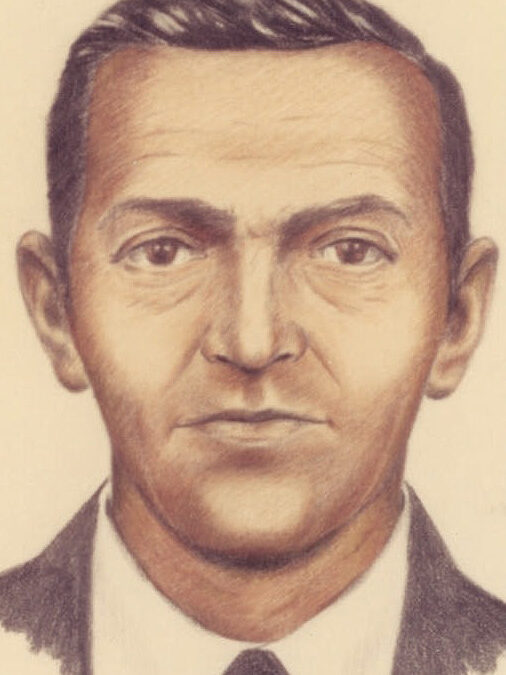
INVESTIGATIVE CASE DOSSIER: THE 1971 D.B. COOPER SKYJACKING
- Perpetrator Alias: “Dan Cooper” (Historically misnamed “D.B. Cooper” by media wires)
- Date of Skyjacking: November 24, 1971 (Thanksgiving Eve)
- Target Aircraft: Northwest Orient Airlines Flight 305 (Boeing 727-100, Tail N467US)
- Route & Drop Zone: Portland, OR to Seattle, WA; Parachuted over southwestern Washington state (Ariel / Lewis River basin)
- Extortion Ransom: $200,000 in non-sequential $20 bills + four parachutes (two main, two reserve)
- FBI Investigation Code Name: FBI Case File “NORJAK” (Northwest Hijacking)
- Key Physical Evidence: Clip-on black necktie with mother-of-pearl tie clip, unexploded cigarette butts, and $5,800 in degraded ransom bills recovered at Tena Bar in 1980
On the rainy afternoon of November 24, 1971, a calm, middle-aged man traveling under the alias “Dan Cooper” boarded Northwest Orient Airlines Flight 305 in Portland, Oregon, bound for Seattle. Shortly after takeoff, he handed a flight attendant a handwritten note claiming he possessed a bomb in his briefcase, demanding $200,000 in cash and four parachutes. After landing in Seattle, exchanging the 36 civilian passengers for the ransom, and ordering the Boeing 727 airborne toward Reno, Nevada, Cooper lowered the aircraft’s aft ventral stairs at 10,000 feet into freezing clouds and jumped into the pitch-black wilderness of southwestern Washington. The D.B. Cooper skyjacking remains the only unsolved case of commercial air piracy in world aviation history.
The Flight 305 Hijacking: Thanksgiving Eve, 1971
On Wednesday, November 24, 1971, a passenger dressed in a dark business suit, white collared shirt, and black clip-on tie bought a $20 one-way ticket for Flight 305 at Portland International Airport. Taking seat 18C aboard the Boeing 727-100, he ordered a bourbon and water before handing a folded note to 23-year-old flight attendant Florence Schaffner. The note read: “I have a bomb in my briefcase. I will use it if necessary. I want you to sit next to me. You are being hijacked.”
When Schaffner sat beside him, Cooper opened his black attaché case, revealing eight red cylinders attached to wires and a cylindrical battery. Cooper dictated his demands: $200,000 in negotiable American currency (specifically ten thousand unrecorded $20 bills), four civilian parachutes, and a fuel truck standing by upon landing at Seattle-Tacoma International Airport.
Flight 305 circled Puget Sound for two hours while Seattle police and the FBI gathered the ransom money from local banks and procured parachutes from an Issaquah skydiving center. At 5:39 PM, the jet touched down at Sea-Tac. Cooper allowed all 36 passengers and two flight attendants to deplane in exchange for the canvas bag of cash and parachutes. After refueling, Cooper ordered Captain William Scott to fly toward Reno, Nevada, at minimum air speed (100 knots), at an altitude under 10,000 feet, and with the cabin unpressurized and the landing gear down.

The Jump into the Void and Operation NORJAK
At approximately 8:05 PM, while flying through severe turbulence, heavy rain, and freezing headwinds over the rugged Lewis River basin near Ariel, Washington, cockpit instruments indicated that the aircraft’s aft staircase had been extended. At 8:13 PM, the aircraft experienced an upward lurch in the tail section, consistent with a heavy weight leaving the stairs.
When the Boeing 727 landed safely at Reno Airport at 10:15 PM with its tail stairs scraping the runway, armed FBI agents and SWAT teams stormed the cabin. Cooper was gone. He had jumped into 15-degree temperatures, a 200-knot wind chill, and blinding rain, wearing only his business suit, loafers, and a lightweight trench coat, carrying the 21-pound ransom bag and wearing two parachutes.
The FBI launched the massive NORJAK investigation, coordinating hundreds of soldiers from Fort Lewis, federal agents, and search helicopters sweeping thousands of square miles of dense forest around Mount St. Helens, Lake Merwin, and the Columbia River. No parachute, body, or gear was found.

Forensic Evidence: The Clip-On Tie and Tena Bar Cash Discovery
Before jumping, Cooper left behind key physical evidence inside the aircraft: an eight-foot length of rope, one of the reserve parachutes, and his narrow black clip-on necktie. In the late 2000s, specialized forensic research teams led by citizen investigator Tom Kaye applied advanced Scanning Electron Microscopy (SEM) and energy-dispersive X-ray spectroscopy to Cooper’s tie.
The microscopic analysis revealed pure unalloyed titanium particles, bismuth, antimony, and rare earth elements embedded in the tie fabric. Because pure titanium was extremely rare in commercial use in 1971—utilized almost exclusively in high-tech aerospace manufacturing facilities such as Boeing’s Super Sonic Transport (SST) program—the forensic findings strongly suggested Cooper was an engineer or metallurgical technician working in the Pacific Northwest aerospace industry.
In February 1980, the only physical evidence of the ransom money was recovered when eight-year-old Brian Ingram, digging in the sand along the Columbia River beach at Tena Bar near Vancouver, Washington, unearthed three bundles containing $5,800 of the original $20 bills. The serial numbers matched the FBI’s NORJAK master list. Geological sediment analysis indicated the bills had been deposited by dredging operations or river currents in 1974, indicating Cooper likely landed in or near a tributary of the Columbia River.

Suspects and the 2016 FBI Case Suspension
Over 45 years of active federal investigation, the FBI interviewed over one thousand individuals and cataloged dozens of high-profile suspects. Prominent names included Richard Floyd McCoy Jr. (who executed a nearly identical 727 skyjacking in Utah in 1972), Sheridan Peterson, Robert Rackstraw, and Kenneth Christiansen. However, none of the suspects matched the composite physical description, the flight attendants’ recollections, or latent fingerprint comparisons.
On July 12, 2016, the FBI Seattle Field Office officially announced the suspension of active investigation into the NORJAK case file, redirecting investigative resources to higher-priority matters while affirming that physical evidence (including DNA profiles and the recovered bills) would be preserved at FBI Headquarters in Quantico, Virginia, for any future definitive forensic match.
The Cooper skyjacking permanently revolutionized global commercial aviation safety. Following the 1971 incident, all commercial Boeing 727 aircraft were retrofitted with an aerodynamic vane known as the “Cooper Vane”—a mechanical latch that prevents aft staircases from being opened during flight. Furthermore, mandatory airport metal detectors and baggage X-ray screening systems were instituted nationwide in 1973, establishing modern airport security infrastructure.
Electron Microscopy & Rare Earth Particle Analysis on the Clip-On Tie
In 2008 and 2011, FBI Special Agent Larry Carr partnered with the Citizen Sleuths research group, led by scientific illustrator Tom Kaye, to conduct advanced electron microscopy on the black clip-on tie left by D.B. Cooper on seat 18E of Flight 305.
Using scanning electron microscopy (SEM) and energy-dispersive X-ray spectroscopy (EDS), researchers identified over 100,000 microscopic particles embedded in the tie fabric. Crucially, they discovered rare unalloyed titanium particles, antimony, and bismuth—elements utilized almost exclusively in Boeing chemical manufacturing plants and titanium fabrication facilities in the Pacific Northwest during the late 1960s, significantly narrowing the suspect’s likely industrial background.
Atmospheric Modeling & The Tena Bar Currency Discovery
In February 1980, eight-year-old Brian Ingram uncovered three bundles of deteriorating bills totaling ,800 along the sandy banks of Tena Bar on the Columbia River, downriver from Vancouver, Washington. Serial numbers matched the ransom money given to D.B. Cooper in Seattle.
Hydrologists and geological sedimentation experts analyzed the diatom algae embedded on the bills, concluding that the money entered the water months after the November 1971 skyjacking. Combined with computer flight-path simulations from the US Air Force and Boeing, the Tena Bar discovery remains the only physical evidence of the ransom money ever recovered in the history of the NORJAK investigation.
Case Timeline & Key Forensic Milestones
| Date / Year | Milestone / Event | Investigative Significance |
|---|---|---|
| November 24, 1971 | Dan Cooper skyjacks Flight 305; parachutes with $200K | Only unsolved commercial skyjacking in world aviation history |
| February 10, 1980 | Brian Ingram discovers $5,800 in degraded bills at Tena Bar | Only physical evidence of the ransom money ever recovered |
| 2008–2011 | Electron microscopy detects pure titanium particles on tie | Links Cooper to Pacific Northwest aerospace industry / Boeing |
| July 12, 2016 | FBI officially suspends active NORJAK investigation | Evidence preserved at Quantico for definitive future match |
Frequently Asked Questions (FAQ)
Did D.B. Cooper survive the parachute jump?
The FBI officially maintains that it is highly improbable Cooper survived jumping into a freezing, 200-mph wind chill over heavily forested, mountainous terrain wearing only street loafers and a business suit. However, because no body, parachute, or gear was ever discovered, his ultimate fate remains an enduring mystery.
Why was the skyjacker called “D.B. Cooper” instead of “Dan Cooper”?
The skyjacker purchased his airline ticket under the alias “Dan Cooper.” Shortly after the hijacking, an early press wire misidentified a local Portland person of interest named D.B. Cooper as the suspect. The media widely broadcast the erroneous initials “D.B.,” and the moniker became permanently fixed in popular culture.
What is a Cooper Vane on an airplane?
A Cooper Vane is a mechanical aerodynamic safety latch installed on the exterior of Boeing 727 and other rear-stair aircraft. When the aircraft is airborne, airflow pushes the vane into a locking position, preventing anyone from opening the aft stairs during flight.



