In December 1978, the disappearance of a fifteen-year-old high school student from a suburban Chicago pharmacy initiated a forensic excavation that exposed the deadliest serial murder burial ground in American history. The John Wayne Gacy Killer Clown crawlspace excavations Chicago unraveled the double life of a prominent contractor, precinct captain, and children’s party clown who butchered thirty-three young men and concealed twenty-nine bodies beneath his suburban ranch house.
Executive Case Factsheet
- Victim(s): 33 murdered young men and teenage boys (including Robert Piest, John Butkovich, John Szyc, Gregory Godzik, Robert Gilroy, Timothy O’Rourke, Frank Landingin, James Mazzara)
- Date of Incident: January 3, 1972 – December 11, 1978
- Primary Crime Scene / Location: 8213 West Summerdale Avenue, Norwood Park Township, Cook County, suburban Chicago, Illinois
- Lead Investigating Jurisdictions: Des Plaines Police Department, Cook County Sheriff’s Office, Cook County Medical Examiner’s Office
- Key Forensic Evidence: 29 skeletal remains excavated from crawlspace beneath 8213 W. Summerdale, 4 bodies recovered from Des Plaines and Illinois Rivers, Kim Ringley photo receipt, rope ligatures
- Suspect(s) / Perpetrator(s):
- Legal Outcome & Status: Convicted of 33 counts of murder in March 1980; sentenced to death; executed by lethal injection at Stateville Correctional Center on May 10, 1994
The Disappearance of Robert Piest & The Pharmacy Photo Receipt
On the snowy evening of December 11, 1978, fifteen-year-old Robert Piest was working as a stock clerk at the Nisson Pharmacy in Des Plaines, Illinois. His mother arrived to drive him home for his birthday celebration, but Robert asked her to wait a moment, explaining that a building contractor remodeling the pharmacy had offered him a higher-paying construction job and wanted to discuss employment outside.
Robert Piest walked out the pharmacy door and never returned. Des Plaines Police Chief Joseph DiLeonardi and Lead Investigator Joseph Kozenczak immediately identified the contractor as thirty-six-year-old John Wayne Gacy Jr., owner of PDM Contractors, who had been inside the pharmacy moments before Piest vanished.
Detectives reviewed Gacy’s background, discovering a 1968 conviction in Waterloo, Iowa, for sodomy on a teenage boy, for which he had served eighteen months in prison. Surveillance teams were placed outside Gacy’s suburban brick ranch home at 8213 West Summerdale Avenue in unincorporated Norwood Park Township.
On December 13, 1978, detectives executed an initial search warrant on Gacy’s home, seizing several high school class rings, driver’s licenses of missing young men, and a critical receipt from a pharmacy film processing counter belonging to a girl named Kim Ringley.
The 8213 West Summerdale Crawlspace Excavations
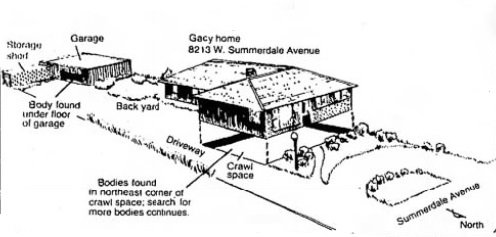
During a second search warrant on December 21, 1978, Des Plaines Detective Mike Albrecht noticed a foul, putrid odor emanating from a heating duct. Albrecht crawled into the unpaved, four-foot-high earthen crawlspace beneath the house, feeling soft, lime-covered depressions in the soil and uncovering a human arm bone protruding from the dirt.
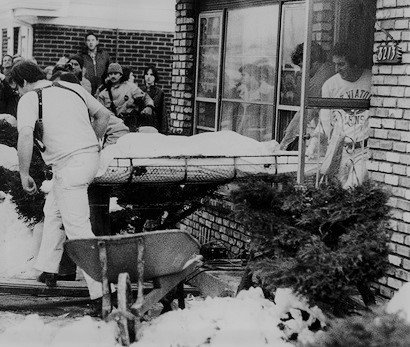
Gacy was arrested immediately on charges of unlawful restraint. Over the subsequent two months, forensic anthropologists led by Dr. Clyde Snow and Cook County Medical Examiner Dr. Robert Stein conducted an archaeological excavation of the crawlspace in sub-freezing winter conditions.
Sifting through cubic yards of damp clay and quicklime, excavation teams unearthed twenty-six bodies crammed into five distinct communal trenches beneath the master bedroom, living room, and hallway. Three additional victims were recovered from the concrete patio, garage floor, and barbecue pit.
Gacy confessed that after filling the crawlspace to capacity in 1978, he began driving victims to rural bridges over the Des Plaines and Illinois Rivers in Grundy County, tossing four final victims—including Robert Piest—into the freezing waters.
The excavation of 8213 West Summerdale Avenue stands as the most complex forensic anthropology and osteological recovery operation in modern American forensic history. Cook County Sheriff’s investigators and physical anthropologists developed groundbreaking 3D spatial mapping protocols to document multi-layered commingled skeletal remains beneath residential crawlspaces. In 2011, Cook County Sheriff Tom Dart initiated an unprecedented genetic genealogical re-investigation using modern STR and mitochondrial DNA profiling, successfully identifying multiple unknown victims including William Bundy and Francis Wayne Alexander over four decades after their murders.
Forensic Odontology, Facial Reconstruction & Clyde Snow Anthropology
Identifying twenty-nine decomposed skeletal remains presented an unprecedented challenge to the Cook County Medical Examiner’s Office. Renowned physical anthropologist Dr. Clyde Snow pioneered revolutionary forensic osteological techniques to determine age, stature, prior bone fractures, and surgical history for each victim.
Forensic odontologists, led by Dr. Edward Pavlik, methodically compared antemortem dental X-rays provided by missing persons’ families across the Midwest with postmortem jaw specimens, successfully identifying twenty-two victims within months.
Pathologists established that Gacy used the ‘rope trick’—a sadistic restraint technique where a nylon cord was looped around the victim’s neck and tightened with a wooden stick or dowel like a garrote until fatal asphyxiation occurred. In several victims, pathologists discovered underwear or cloth wads shoved deep into the pharynx to muffle screams.
For the remaining unidentified remains, forensic artists created pioneering three-dimensional clay facial reconstructions from the skulls, publishing them internationally to solicit leads from missing persons databases.
The Trial, The Insanity Defense & Dr. Morrison Psychiatric Analysis
The trial of John Wayne Gacy commenced on February 6, 1980, at the Cook County Criminal Courthouse in Chicago before Judge Louis Garippo. Defense attorneys Sam Amirante and Robert Motta presented an insanity defense, claiming Gacy suffered from paranoid schizophrenia and multiple personalities that completely detached him from reality during the homicides.
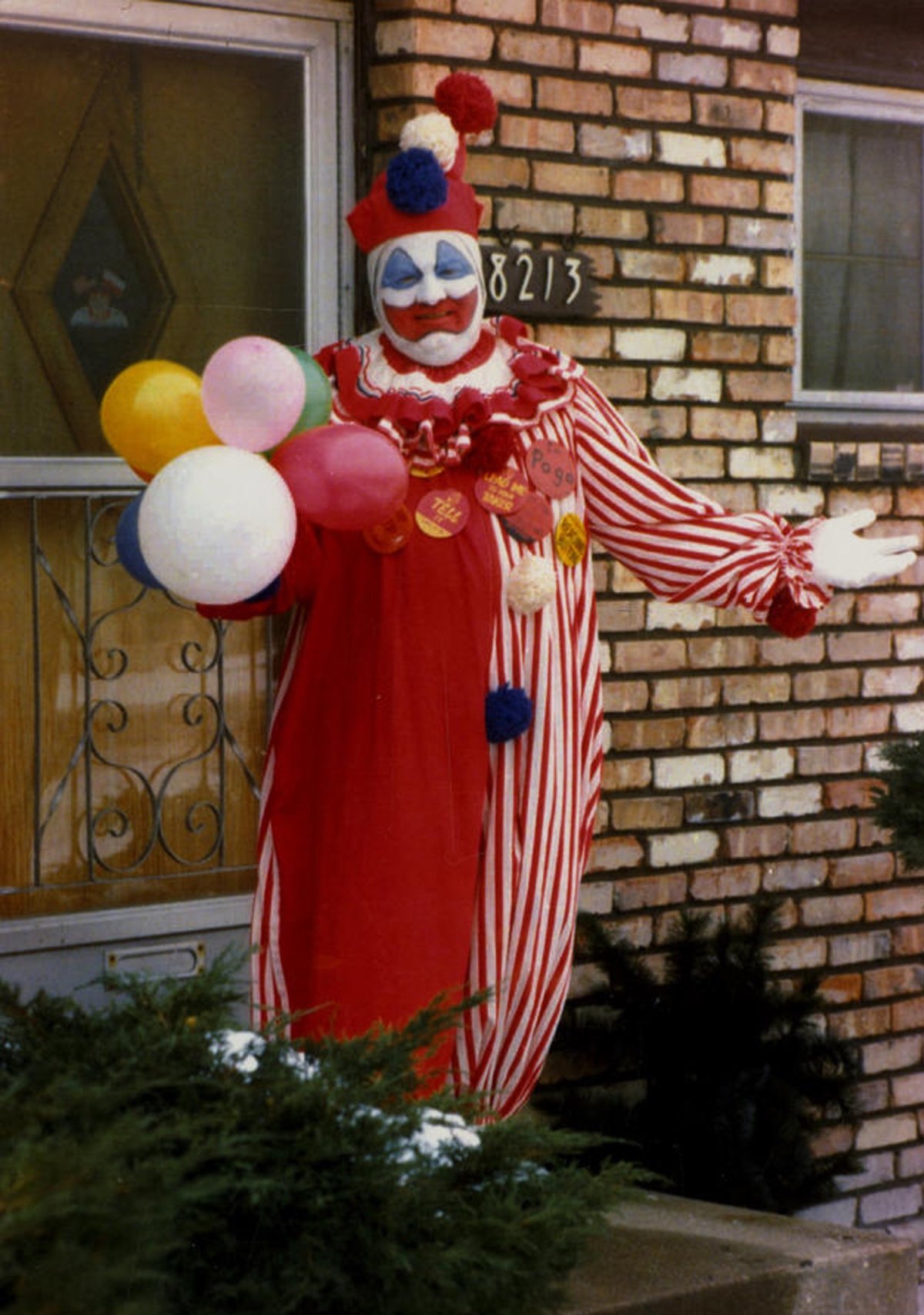
Prominent defense psychiatrist Dr. Helen Morrison testified that Gacy lived in a fantasy world where he compartmentalized his identity as ‘Jack Hanley’, a cruel killer distinct from his benevolent civic persona as ‘Pogo the Clown’ and Democratic precinct captain.
Prosecutors William Kunkle and Terry Sullivan systematically dismantled the insanity claim, demonstrating that Gacy acted with cold, methodical premeditation: purchasing hundreds of pounds of lime in advance, stockpiling nylon ropes, digging trenches in his crawlspace days prior to murders, and creating elaborate alibis.
On March 13, 1980, after only two hours of jury deliberation, Gacy was convicted of all thirty-three counts of murder—the most murder convictions ever handed down to an individual in American history at that time—and sentenced to death.
Stateville Execution, Modern DNA Identifications & Historical Impact
Gacy spent fourteen years on death row at the Menard Correctional Center. On May 10, 1994, John Wayne Gacy was executed by lethal injection at Stateville Correctional Center in Crest Hill, Illinois, famously uttering his unrepentant final words: ‘Kiss my ass.’
In 2011, Cook County Sheriff Thomas Dart reopened the cold case files for the eight remaining unidentified Gacy victims, exhuming the remains to extract modern STR DNA profiles and comparing them against national DNA databases.
This ongoing genealogical effort has successfully identified multiple additional victims: nineteen-year-old William George Bundy in 2011, sixteen-year-old James Byron Haakenson in 2017, and Francis Wayne Alexander in 2021, bringing long-sought closure to families fifty years after their disappearances.
The John Wayne Gacy investigation remains a historic foundational milestone in physical forensic anthropology, crawlspace recovery archaeology, and the deployment of familial DNA to resolve historical mass murder archives.
Chronological Case Timeline
| Date / Milestone | Investigative Development | Forensic / Evidentiary Significance |
|---|---|---|
| December 11, 1978 | Robert Piest disappears from Nisson Pharmacy | Last seen with contractor Gacy; police launch surveillance |
| December 13, 1978 | First search warrant executed on Summerdale home | High school rings and photo receipt seized |
| December 21, 1978 | Human bone discovered in crawlspace; Gacy arrested | Cook County launches archaeological crawlspace excavation |
| December 1978–March 1979 | 29 bodies excavated from property; 4 from rivers | Dr. Clyde Snow and odontologists identify 22 victims |
| March 13, 1980 | Gacy convicted of 33 murder counts; sentenced to death | Most murder convictions in US history at that time |
| May 10, 1994 | John Wayne Gacy executed at Stateville Prison | Lethal injection carried out in Crest Hill, Illinois |
| 2011–2021 | Sheriff Dart uses DNA to identify 3 more victims | Bundy, Haakenson, and Alexander identified via modern STR DNA |
Frequently Asked Questions: Forensic & Legal Review
How did police discover the bodies buried under John Wayne Gacy’s house?
During a search warrant on December 21, 1978, following the disappearance of fifteen-year-old Robert Piest, a detective noticed a foul odor coming from a heating vent. Crawling into the unpaved crawlspace under the house, he discovered human bone protruding from lime-treated soil. Excavations eventually recovered 29 bodies from the property.
Why was John Wayne Gacy known as the ‘Killer Clown’?
Gacy was a member of the ‘Jolly Jokers’ clown club and regularly dressed up in makeup and custom costumes as ‘Pogo the Clown’ or ‘Patches the Clown’ to perform at children’s birthday parties, charity events, and pediatric hospitals in suburban Chicago while secretly carrying out serial abductions.
How many Gacy victims have been identified using modern DNA?
Between 2011 and 2021, Cook County Sheriff Thomas Dart exhumed the remaining unidentified skeletal remains for modern STR DNA testing. This initiative successfully identified William George Bundy (2011), James Byron Haakenson (2017), and Francis Wayne Alexander (2021).